
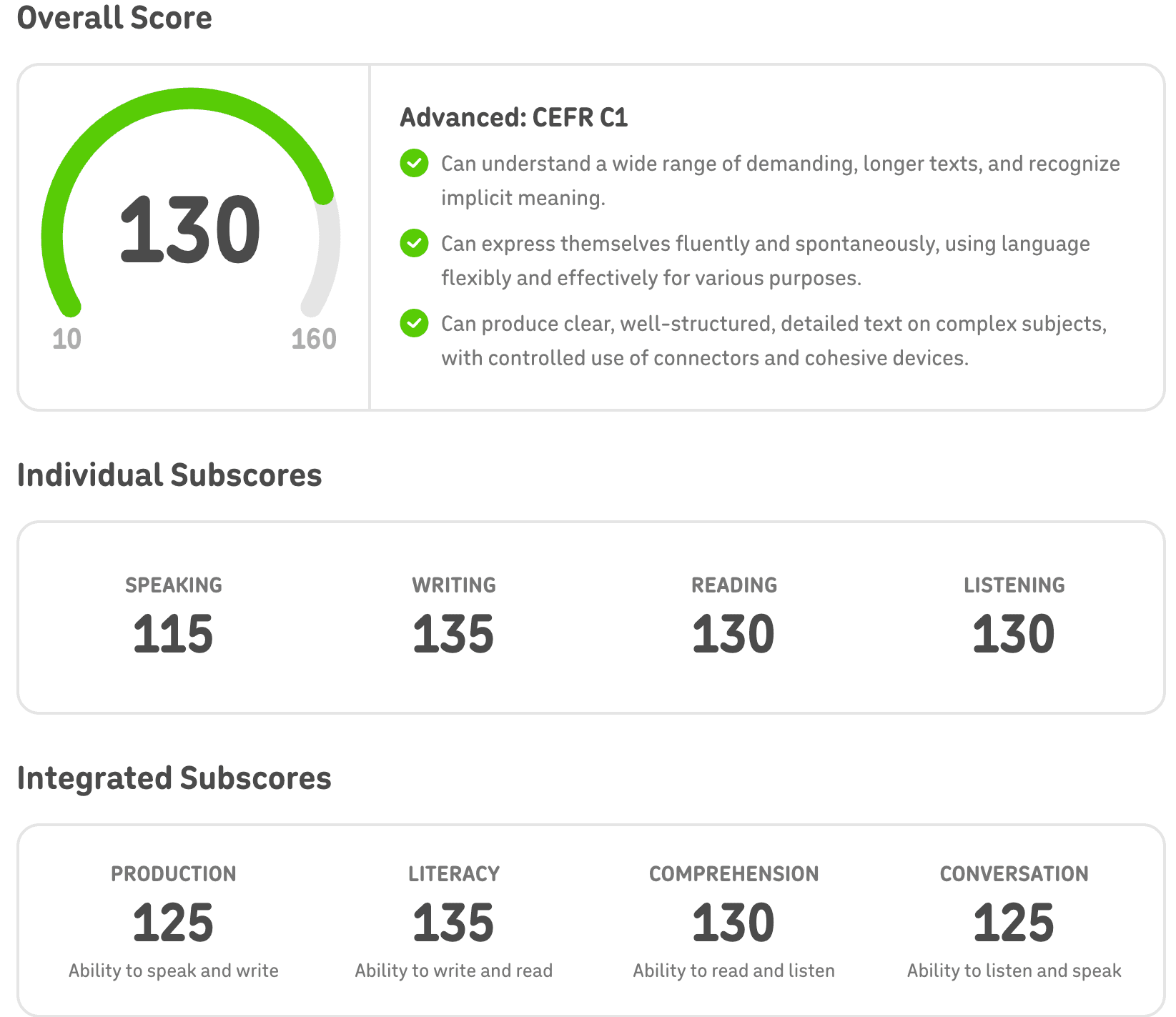
I recently completed the Duolingo English Test (DET), and I wanted to share a few things I learned along the way. The DET is an online English proficiency test accepted by many universities and institutions as proof of English language proficiency for admission to programmes abroad. Acceptance requirements vary, so it is always worth checking the requirements of the programme you are applying to. I got 130.
My journey with the test was short but fruitful. Some people asked me how I prepared and how long it took, so here I am sharing my experience.
As usual, I made the same mistake I often make: not giving myself enough time before a deadline. I needed my results before an approaching deadline, and I had less than a week to prepare.
On the first day, I spent a few hours answering practice questions on the official Duolingo English Test website. Later that day, I moved to Arno, a platform for English exam preparation that offers a 24-hour free trial. I completed a mock test for all four sections. After each section, I carefully reviewed my mistakes, wrote them down, and reflected on what I could do differently to improve.
The following day, I accessed another 24-hour trial through a friend email and completed a full mock test. This time, I tried to apply the strategies I had identified the day before while continuing to review my mistakes.
On the third day, I watched a few YouTube videos about DET tips and tricks including teacher Luke.
The following day was the day of the test I had anticipated. I started wandering around to find a suitable place to take the actual test, with stable internet and electricity. I eventually found a workspace, but the room was not isolated nor comfortable, and had alot of background noise. Nevertheless, I purchased the test. I bought it through the DET Ready website, using a 10% discount with the option to receive results within 24 hours, and started preparing to take it. That was when I discovered something I had not adequately prepared for: the test setup itself.
My phone, which I needed for the room scan, was almost out of battery and had to be charged. Getting everything ready took me nearly an hour. Eventually, I started the test, and everything seemed to be going well until it crashed about ten minutes before I was due to finish. Ironically, that attempt turned out to be my best one.
I was frustrated and stressed, but I tried to restart the test. My internet connection failed before I could complete it. I tried again, but I was too overwhelmed to concentrate properly, so I closed the test. The platform then indicated that I had lost all three test credits included with my purchase and would need to buy another test. I went home frustrated and disappointed.
The next morning, I woke up determined to get it done that day. I went to search for another workspace, only to find that its internet connection was weak and unstable. I moved to another place, but there was no available space where I could take the test undisturbed. Noise seemed to be everywhere. Eventually, I discovered a place with isolated meeting rooms and a stable internet connection. That was where I finally sat down and completed the test.
To be honest, it felt harder than the mock test I had taken days before and the test from the previous day. But by that point, I wanted to get it done, and I was determined to see it through. And Alhamdulillah, the result was better than I had expected, even higher than my mock-test scores.
Looking back, the experience taught me much. Here are a few lessons I would share with anyone preparing for the Duolingo English Test.
Tips I learned from my experience
1. Start early, even if you think you only need a few days.
Don't leave preparation until the deadline is approaching. A few days may be enough for some people to familiarise themselves with the test, but starting early gives you time to practise, identify weaknesses, and improve your score while learning from your mistakes.
2. Practise the format, not just your English.
Being comfortable with English does not automatically mean you will perform well in every test task. Spend time understanding the different question types and practise responding within the time limits. Practise through either the official DET website or other sources like the Arno website. You do not need to spend all your time watching preparation videos; actual practice can reveal much more about where you need to improve.
3. Review your mistakes instead of simply taking more mock tests.
This was one of the most useful parts of my preparation. After every section, I wrote down my mistakes and thought about how to improve. The next day, I tried to apply what I had learned. A mock test is not just a way to estimate your score. It is an opportunity to identify patterns in your mistakes and work on them.
4. Treat time management as a skill.
Under time pressure, it is easy to spend too long on one question or overthink a response. Practise making clear, direct answers without trying to produce a perfect sentence every time. Practise responding within the time limit, especially in speaking and writing tasks.
5. Prepare your testing environment in advance.
This lesson cost me time, stress, and test credits. Choose the location the day before. Do not settle for a place simply because it has Wi-Fi. Make sure you have a quiet, private room where you can follow the official test rules without interruptions. Check your computer, phone, microphone, camera, and identification documents. Understand the official test rules. Technical preparation is part of test preparation.
6. Do not let a difficult mock test define your expectations.
My final score was higher than my mock-test scores, which was a pleasant surprise. Practice tests are useful indicators, but they are not guarantees of your final result. Use them to identify what needs work, rather than allowing one disappointing score to undermine your confidence.
7. For the different sections.
Use a simple but organized structure for your answers. For example, after the interactive listening question, you need to summarize the talk; mention who you talked to and what about, details, and outcome. Make your main point, explain it, and give an example when appropriate. Clear communication is more useful than forcing complicated vocabulary into every answer. Expect longer listening audio to write down than in mock tests, with different dialects.
8. Understand the test-credit and retake policies before starting.
I learned this lesson the hard way. Before purchasing or launching the test, read the current rules on technical interruptions, invalid attempts, retakes, and test credits.
Final thoughts
I would not describe my preparation as ideal, and I certainly would not recommend repeating the mistakes I made. But the experience reminded me that progress does not always come from following a perfect plan. Sometimes, it comes from learning quickly, adapting when things go wrong, and continuing until you get there.
If you are preparing for the DET, I hope some of these lessons help you avoid the problems I encountered and make your own experience a little smoother.
And if you have taken the test yourself, I would love to hear what worked for you.