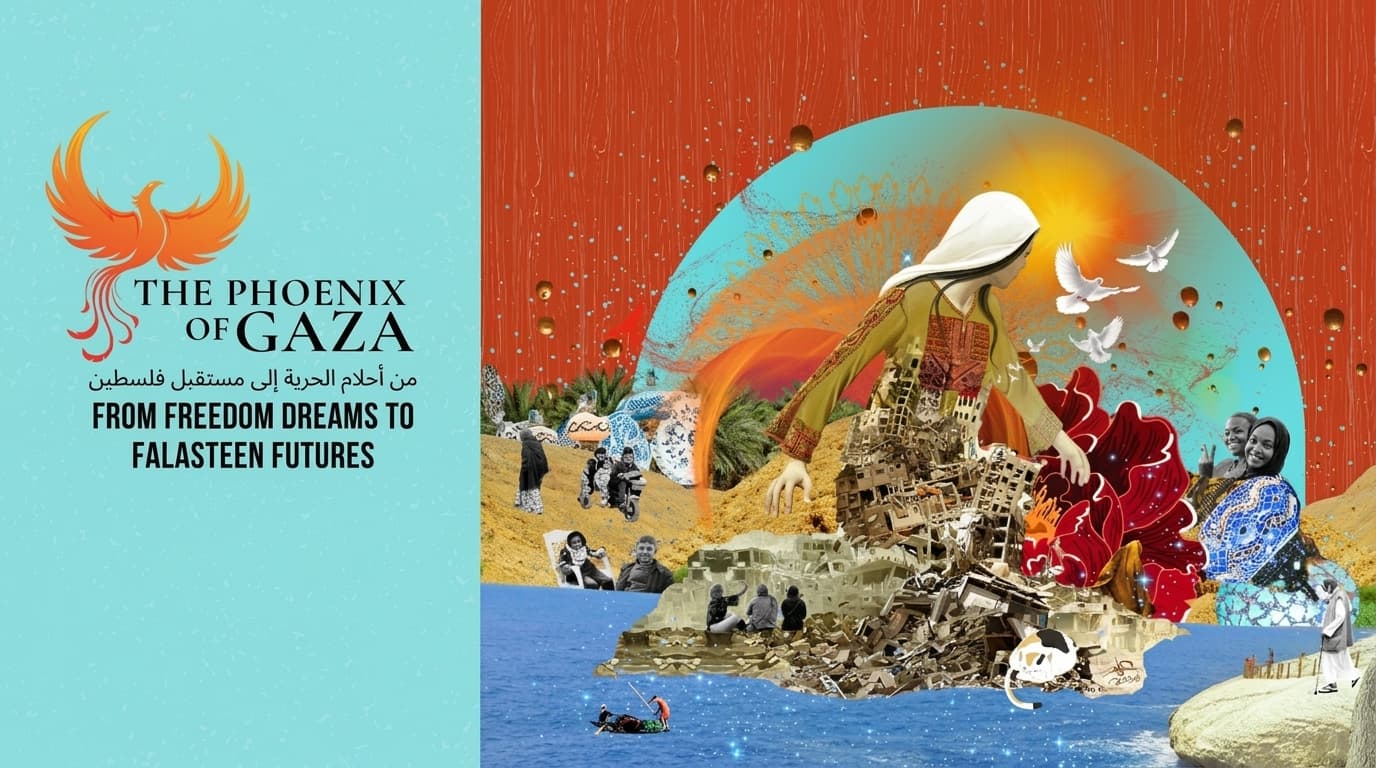
I first heard about the Phoenix of Gaza XR project during the social medicine course I took last year. At the time, I knew its general idea, but two days ago, during an online alumni workshop with its founders, Naim Aburaddi and Dr. Ahlam Muhtaseb, I had the opportunity to gain a deeper understanding of what the project means and why it matters.
Launched in 2022, a year before the genocide, Phoenix of Gaza XR used immersive technology to preserve and share Gaza’s history, culture, and everyday life through 360-degree footage and virtual recreations. It allowed people to visit places and experience aspects of life that conventional media could rarely convey: its streets, markets, historical sites, family gatherings, and ordinary moments. It allowed people abroad to see the essence of human life away from the siege, bombardment, and breaking news.
However, since the genocide began, the project’s purpose changed dramatically. What had started as a small university project became a national treasure of the life that had been wiped out. An archive that was not planned or anticipated in quite this way. During the workshop, the founders took us through their journey and panic to protect the project and its data amid smear campaigns. Their sense of urgency in registering it as an independent limited liability company (LLC), and their willingness to pay out of their own pockets to keep it alive, spoke volumes.
As I explored the project during and after the workshop, I felt a deep sense of nostalgia when I encountered Hammam al-Samra, the historic bathhouse in Gaza’s Old City, and the nearby Gold Street. These were not simply locations on a map or historical sites to be viewed through virtual reality. They were places that held personal memories for me. I would pay ten times what I used to pay to revisit them and experience them again. But I cannot.
I used to visit Hammam al-Samra with my cousins every since and a while. Enjoing the sauna, the hot baths, and the massage. Enjoing looking around at the bathhouse's old brick walls. Waiting for the boiling-hot droplets of condensed steam to form overhead, fall on our shoulders, and dodging it. We used to do so. Afterward, we would wander through the narrow alleys toward the Gold Market nearby, then head to the Great Omari Mosque. We would deliberately get lost in the crowded streets, discovering new shops and markets along the way, until we eventually made our way to Akeela’s falafel shop near Shuja’iyya.
We used to do all of this. We cannot anymore.
Hammam al-Samra has been destroyed, the Great Omari Mosque has been partially destroyed, the surrounding area has been devastated and the crowded streets were left abandoned. The so-called Yellow Line adds an extra layer of the danger and isolation.
Suddenly, the project was no longer an abstract initiative using technology to preserve cultural heritage. It was about a place I knew, a place that belonged to my own life and that I can no longer revisit as I remember it. That is what makes this work particularly meaningful to me. A place does not become important only because of its age, architectural value, or historical significance. Sometimes, its value lies in the ordinary memories people have made there, without ever imagining that one day those experiences might need to be preserved as a record of what once existed.
War destroys buildings, but it also threatens the connections between people and the places that give their lives meaning. When those places disappear, photographs, recordings, and digital reconstructions may become some of the few remaining ways to revisit them. Preserving images, sounds, and memories, in this context, becomes an act of documentation and resistance to erasure.
Phoenix of Gaza XR cannot reverse destruction. A virtual reconstruction cannot replace a real place or restore the lives disrupted by war. But it can preserve evidence of what existed. It can allow people who have never visited Gaza to encounter something beyond the dominant images of devastation, and it can help Palestinians revisit places that remain part of their personal and collective memory.
For those of us who have lived through these events, such an archive is not simply for future generations. It is also for the present, for those moments when we need to remember that Gaza was, and remains, much more than what has been done to it.
The founders also took us through a painful story behind the footage that made this project possible. Photojournalist Yaha Sobieh, who captured much of the footage used in the archive, was killed in an Israeli airstrike in May 2025. Like many Palestinian journalists, he worked to document Gaza and made its reality visible to the world. His work did not capture suffering alone; it also preserved evidence of life, places, and experiences that might otherwise disappear from view. A life that was snitched away from him. His killing was an immense loss, both personally for those who knew him and for the project’s efforts to continue documenting Gaza during the genocide.
His death interrupted the project’s post-genocide documentation work, but the effort was later revived by his wife, Amal. Her name means “hope” in Arabic. She stepped forward to help carry the work forward, a continuation that brings to mind the project’s own name: the phoenix rising from beneath the rubble.
There is something deeply moving about this. The project seeks to preserve a city under attack, while the people behind it have themselves endured loss. Yet the work continues, carried forward by those who refuse to let the record disappear.
I left the meeting thinking about the different ways Gaza is being documented. As a doctor and researcher, research have become how I make sense of these experiences and resist erasure. But I have also come to recognize another kind of record that we need that I couldn't think of. One that remembers not only what happened to us, but also how we lived before and during it. One that allows us to take a virtual walk through the streets we knew, revisit places we loved, and reconnect with parts of our lives that war has taken from us. The Phoenix of Gaza XR project reminded me that these memories deserve to be preserved, too.
I do not know what Gaza will look like in the years to come, how many of the places I remember will be restored, or how many details of my own memories time will cause me to lose. But I know that rebuilding a place is not only about reconstructing its buildings. It is also about preserving the memories, relationships, and sense of belonging that make it home.
Sometimes, that work begins with making sure that a place like Hammam al-Samra is not remembered only as something that was destroyed, but as somewhere people once went with their families, made memories, laughed, and lived their lives.
I am grateful to have had the opportunity to learn more about this project and the people behind it. I encourage readers to explore the Phoenix of Gaza XR project and discover the Gaza it seeks to preserve.
I would also encourage nonprofit organizations and teams interested in hosting a virtual reality museum experience of pre-war Gaza to contact the project team. As explained during the workshop, the team offers this experience free of charge to nonprofit organizations and teams and are more than happy to support.
Because Gaza deserves to be remembered not only for what it has endured, but also for everything it has been, and for the lives that made it home. The founders made this project possible not only as a palestinians but as a humans who refused to let go of a city that had been left to let go by the world.